
FIELD STUDY 001 — 2015/2016
Party Pieces
Trust Infrastructure and the Modernization Paradox
Core Doctrine
Organizations become fragile when modernization disconnects from the systems that originally created trust, differentiation, and demand.
I. Opening Context
Party Pieces was a well-established UK retail brand founded by the Middleton family. By 2015, it had operated successfully for nearly three decades, building customer trust through a distinctive catalogue-era model that combined product curation with tactile brand presence.
The business represented something increasingly rare in ecommerce: differentiation that was not purely transactional. Customers did not simply purchase party supplies. They engaged with a brand that had accumulated trust through consistent delivery, quality curation, and physical touchpoints that reinforced identity.
This study documents an engagement during a period of digital transition and examines the organizational patterns that emerged under modernization pressure.
II. Organizational State
At the time of engagement, Party Pieces was commercially healthy, operating at approximately £3–5 million annual turnover with approximately £1 million annual profit. These figures represent contextual public information about the business during that period.
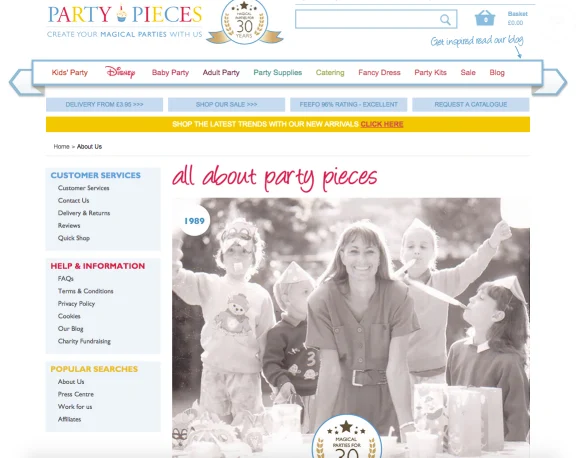
Evidence Artifact — Trust Infrastructure
Party Pieces built customer familiarity through recognizable brand identity, family-rooted positioning, and catalogue-era trust infrastructure that accumulated over decades.
The operational infrastructure included strong catalogue-era heritage, recognizable customer trust mechanisms, and a brand identity that had compounded over decades. The catalogue was not merely a sales channel. It functioned as trust infrastructure.
Observation: Organizations that build trust through physical touchpoints often underestimate what those touchpoints actually provide. The catalogue was not distribution. It was differentiation infrastructure.
The engagement occurred during a period where digitally measurable acquisition systems were becoming increasingly important as ecommerce behavior evolved. The question was not whether to modernize, but how to modernize without disconnecting from the leverage that had created commercial stability.
III. Structural Pressure
The structural pressure was familiar to any established business navigating digital transition. Ecommerce behavior was shifting. Digitally measurable acquisition systems were becoming expected rather than optional. The operational question appeared straightforward: build digital demand infrastructure.
However, the deeper structural reality was more complex. The business had accumulated leverage through systems that predated digital measurement. Customer trust, brand recognition, and purchasing rituals had been built through physical catalogue distribution over decades.
Organizational Tension Diagram
Trust Infrastructure
- —Catalogue presence
- —Customer familiarity
- —Purchasing ritual
- —Tactile identity
- —Differentiation layer
Leverage
Tension
Modernization Pressure
- —Ecommerce behavior shift
- —Efficiency optimization
- —Scaling pressure
- —Competitive urgency
- —Digital measurement
The pressure was not simply to add digital capabilities. The pressure was to add digital capabilities without understanding what the existing systems actually provided.
This is where most modernization creates fragility rather than strength.
IV. Leverage Diagnosis
The diagnosis began with a simple question: what systems currently create trust, differentiation, and demand?
Layered Transition Pressure
Internal Pressure
- Infrastructure transition
- Scaling digital demand
- Identity preservation
- Operational adaptation
External Pressure
- Ecommerce behavior shift
- Changing purchasing habits
- Market modernization
- Competitive pressure
The catalogue was not merely a distribution mechanism. It functioned as:
Trust Infrastructure
Physical presence reinforced legitimacy and reliability
Identity Reinforcement
Tactile brand experience created emotional connection
Customer Ritual
Browsing behavior became purchasing habit
Differentiation Layer
Non-replicable by purely digital competitors
The operational insight was clear: any digital modernization that treated the catalogue as merely a cost center rather than leverage infrastructure risked disconnecting from the systems that created the commercial position.
The engagement focused on building digital demand infrastructure that complemented rather than replaced the existing leverage architecture.
V. Architectural Intervention
The intervention focused on building digitally measurable acquisition systems that maintained awareness of the existing leverage architecture. The approach treated digital marketing not as a replacement for catalogue-era trust, but as a complementary infrastructure layer.
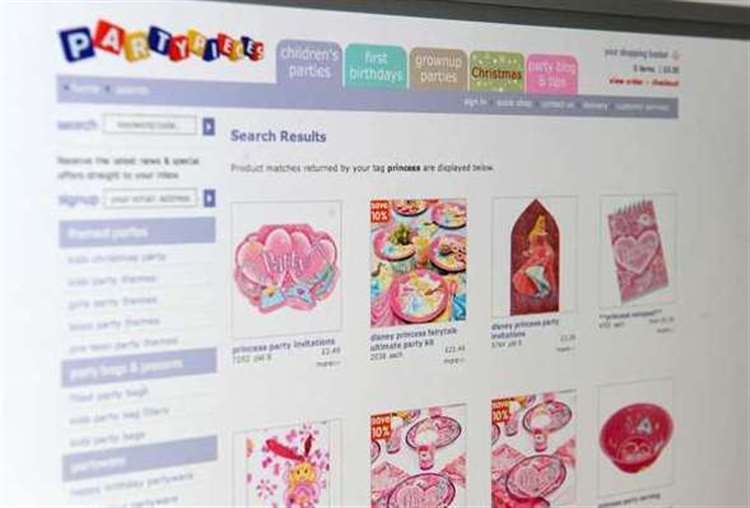
Segmented Navigation
Themed Pathways
Evidence Artifact — Digital Infrastructure
Early segmented ecommerce infrastructure during the organization's transition toward digitally measurable acquisition systems. Note themed navigation structure and category architecture.
Key architectural decisions:
- 01Segmented acquisition pathways designed around customer intent
- 02Themed purchasing pathway strategy aligned with brand identity
- 03Ecommerce-focused acquisition systems with clear attribution
- 04Digital demand infrastructure that preserved brand positioning
The intervention was not about proving digital marketing worked. It was about demonstrating that digital systems could extend leverage rather than replace it.
VI. Operational Validation
The engagement produced measurable validation of the architectural approach:
£23,460
Attributed Campaign Revenue
£138
Average Order Value
Acquisition Pathway Architecture
Customer Intent
Segmented Entry Path
Themed Purchasing Journey
Higher Basket Value
Measurable Revenue Visibility
Beyond the direct metrics, the engagement demonstrated that digital acquisition infrastructure could operate alongside existing trust systems without requiring their removal or replacement.
The validation was not about scale. It was about proof of concept: modernization with leverage awareness.
VII. Later Environmental Context
The years following the engagement brought significant environmental changes. Ownership transitioned. Strategic decisions shifted. The catalogue distribution model was eventually removed. Expansion pressure increased. COVID created additional market disruption.
Organizational Arc — Observed Timeline
Catalogue Era — Brand trust accumulation
Digital Transition — Engagement period (2015–2016)
Operational Modernization
Ownership Transition
Catalogue Removal
Expansion Pressure
COVID Disruption
Administration
Brand Acquisition
The business later entered administration. The brand was subsequently acquired by interests connected to James Sinclair.
This later context is included only as environmental observation. It should not be interpreted as commentary on ownership decisions, management choices, or operational direction beyond the engagement period.
The purpose of including this context is observational: to demonstrate how organizational architecture behaves under changing conditions, not to assign responsibility for outcomes that occurred years after the documented engagement.
VIII. Doctrine Observation
The Party Pieces study reinforces a recurring pattern observed across organizational transitions:
“The catalogue was not merely a sales mechanism.
It functioned as trust infrastructure.”
Modernization without leverage awareness creates fragility.
The problem was never modernization itself. Digital acquisition systems were appropriate and necessary. The problem emerges when modernization disconnects from understanding what created the original commercial position.
The catalogue was not simply an old sales mechanism that needed replacing. It was trust infrastructure, identity reinforcement, tactile differentiation, customer ritual, and brand continuity combined into a single operational system.
Organizations that understand their leverage architecture can modernize while preserving what created their position. Organizations that treat modernization as replacement rather than extension often weaken the systems that made them differentiated.
IX. Parallel Observation
The same pattern appears in how many organizations now approach AI adoption.
The pressure to automate. The urgency to implement. The assumption that efficiency gains justify removing human touchpoints. The belief that modernization requires replacing existing systems rather than extending them.
AI-Era Parallel — Structural Risk Pattern
Trust Systems
- —Human familiarity
- —Differentiation
- —Identity systems
- —Customer ritual
- —Trust continuity
Modernization
Without
Leverage
Awareness
Automation Risk
- —Over-automation
- —Efficiency-only thinking
- —Brand sameness
- —Operational flattening
- —Trust erosion
Organizations are making the same structural mistake with AI that others made with digital transformation: automating trust away, removing human systems too quickly, optimizing efficiency while weakening differentiation.
The organizations that will maintain differentiation in the AI era are those that understand what creates trust, what creates differentiation, and what systems need to be preserved even as execution infrastructure evolves.
Leverage awareness remains the determining factor.
X. Ecosystem Context
Patterns like these do not emerge from a single engagement. They accumulate through repeated observation across industries, organizational stages, and market conditions.
Over time, recurring organizational patterns like these became part of the operational thinking that shaped Echelon and the broader Aether ecosystem.
The worldview did not emerge from positioning exercises. It emerged from documented operational reality.
FIELD STUDY 001
Organizational Studies — Aether